
TL;DR

Get travel and outdoor gear delivered free with Prime
- Fast, free delivery on millions of items
- Prime Video, Amazon Music and more included
- Member-only deals all year
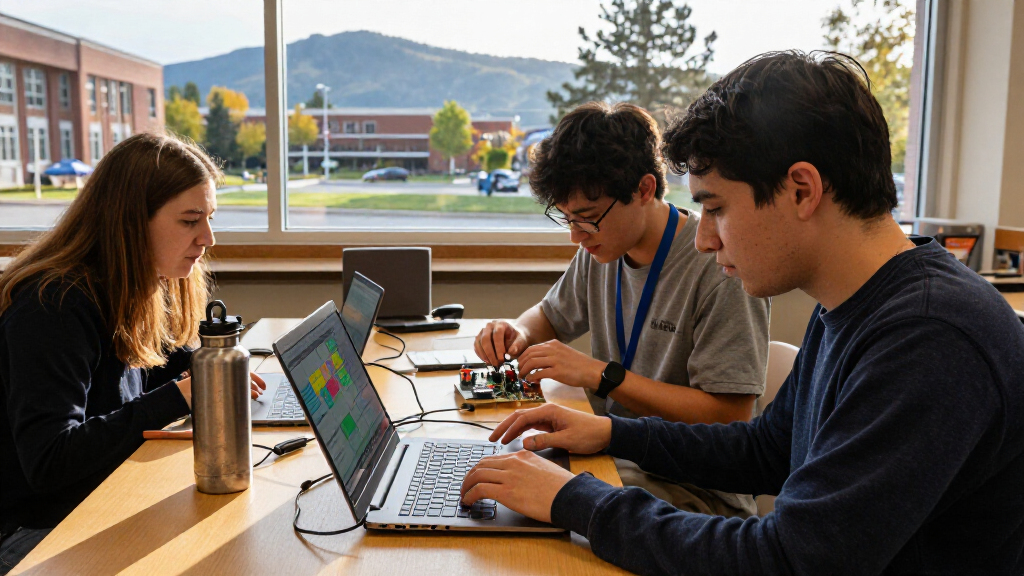
Google says students presented three projects addressing Colorado electricity challenges at its second annual Colorado Impact Hackathon in Boulder. The ideas focus on residential solar planning, batteries during wildfire-related shutoffs and predictive grid hardening; the report does not say any project has been deployed or tested in the field.
Students presented three energy-focused projects at Google’s second annual Colorado Impact Hackathon in Boulder, proposing tools for residential solar planning, battery storage during wildfire-related power shutoffs and targeted grid upgrades. Google said the event was held with the University of Colorado Boulder and the Colorado Energy Office; its report describes the projects but does not establish that they have been deployed or independently evaluated.
Google identified SolarSnap as the first-place project. The team proposed an AI-powered app that would use a homeowner’s phone camera to help identify a suitable setup for solar panels. Google’s account does not describe the app’s technical design, how it would calculate a recommendation or whether it is available to homeowners.
Grid Watch took second place. Google described it as an AI-managed battery network designed to keep electricity available during wildfire-related shutoffs while reducing power costs. The report gives no details on battery locations, ownership, operating arrangements or how the concept would function during an actual shutoff.
The third-place project, Grid Guard, would provide predictive capabilities to support targeted grid hardening. Google did not specify what data it would use, which parts of the grid it would assess or what measures a utility might take based on its predictions. The report also says Colorado Attorney General Phil Weiser and CU Boulder Vice Chancellor for Sustainability Andrew Mayock spoke at the event about innovation and the state’s clean-energy future.
Student Ideas Meet Grid Pressures
The projects address problems with practical consequences for Colorado households and energy providers: the cost and complexity of residential solar, maintaining power during wildfire-related shutoffs, and deciding where grid improvements may be needed. These are proposals from a student competition, not evidence that the challenges have been solved. Their significance at this stage is that they put several local energy concerns into concrete product and planning concepts.
For readers, the distinction between an idea and an operating service matters. Google’s report does not provide test results, budgets, utility partnerships or a schedule for implementation. The projects could attract further attention or development, but no such next step is confirmed in the available account.
Products Worth Considering

EGO Power+ PST3041 3000W Nexus Portable Power Station with Four 5.0Ah Batteries

EGO Power+ 9-Gallon Cordless Wet/Dry Shop Vacuum (WDV0904) with 56V 5.0Ah Battery and Charger

EGO Power+ 16 Cordless Chainsaw (CS1611) with 56V 2.5Ah Battery and Charger
As an affiliate, we earn on qualifying purchases.
How the Boulder Hackathon Worked
Google described the gathering as the second annual Colorado Impact Hackathon, held at its Boulder offices in partnership with CU Boulder and the Colorado Energy Office. Participants were asked how Colorado could create a clean, secure and resilient electric grid. The three named projects were ranked first, second and third in the competition, according to Google.
The company framed the event as collaboration among students, public leaders and technology workers, and connected the challenge to concerns including wildfire risk and energy backlogs. Those points are part of Google’s account of the event; the report does not define the backlogs or provide measurements of the state’s grid needs.
“How can we create a clean, secure, and resilient electric grid in Colorado?”
— Google, in its October 29, 2026 report
Projects Still Need Validation
The report does not identify the student teams or disclose their project materials, technical methods or competition judging criteria. It also does not say whether any idea will receive funding, move into a pilot, partner with a utility or be developed beyond the hackathon.
Claims about potential reliability, cost savings and predictive performance remain unverified in the report. No estimates, field trials or comparisons with existing tools are provided. It is also unclear whether the Colorado Energy Office or any electricity provider plans to review or use the concepts.
No Follow-Up Plan Announced
Google’s report announces the winners but does not set out a follow-up timetable or name a next milestone. Further information would be needed to establish whether the teams will refine their prototypes, seek technical or financial support, or test their concepts with homeowners, utilities or public agencies.
For now, the confirmed development is the hackathon and its three ranked proposals. Any rollout or measurable impact on Colorado’s electricity system remains undetermined.
Key Questions
What happened at the Colorado Impact Hackathon?
Students presented projects addressing Colorado grid challenges at Google’s second annual event in Boulder, held with CU Boulder and the Colorado Energy Office.
Which project won first place?
SolarSnap placed first. Google described it as an AI app that would use a phone camera to help homeowners find a solar-panel setup.
What were the other winning projects?
Grid Watch placed second with a proposed battery network for wildfire-related shutoffs and electricity costs. Grid Guard placed third with predictive capabilities for targeted grid hardening.
Are the projects available or in use?
Google’s report does not say that any project has been launched, tested in the field or adopted by an energy provider.
What happens next?
No next steps or implementation schedule were announced in the report. Whether the teams will develop or test their ideas remains unclear.
Source: blog.google