

Portable travel power adapters help you connect devices to outlets abroad, but not every adapter converts voltage or suits high-wattage electronics. I rank the EPICKA 70W GaN Universal Travel Adapter as the best overall choice in this lineup for travelers who want several USB-C ports and stronger charging capacity. The Anker Nano 5-in-1 is a more compact, lower-power option, while the TESSAN Type C 2-Pack suits trips focused on European outlets and simple plug access. The main tradeoffs are charging speed, outlet coverage, size, and whether you need one adapter or several. Read on for the full breakdown and help matching an adapter to your devices and itinerary.

Get travel and outdoor gear delivered free with Prime
- Fast, free delivery on millions of items
- Prime Video, Amazon Music and more included
- Member-only deals all year
Complete the kit


Key Takeaways
- The EPICKA 70W GaN model is the strongest all-around fit for multi-device charging: its stated 70W output and three USB-C ports set it apart from the lower-wattage compact options.
- The Anker Nano 5-in-1 favors portability over charging headroom: its 20W rating makes it a better match for phones and small devices than for faster-charging laptops.
- European-only adapters can be more practical than worldwide models on a focused itinerary: the TESSAN 2-pack provides two Type C adapters, while the LENCENT adds multiple outlets and USB ports in a foldable design.
- Outlet counts do not tell the whole story: the Ceptics 35W kit offers two US outlets, but travelers should compare its total USB output and plug coverage with the higher-output Ceptics 45W model.
- A travel adapter is not automatically a voltage converter: travelers with appliances such as hair dryers must check device voltage and adapter limits before plugging them in.
| Anker Nano 5-in-1 Travel Adapter, 20W |  | Best Compact Universal Pick | USB ports: 2 USB-C, 2 USB-A | AC outlets: 1 | Maximum USB output: 20W; 15W shared | VIEW LATEST PRICE | See Our Full Breakdown |
| Anker Nano 5-in-1 Universal Travel Adapter, 20W |  | Best Compact Pick for Coordinated Gear | Ports and outlets: 1 AC, 2 USB-A, 2 USB-C | Maximum USB output: 20W total; 15W shared | Single USB-C output: Up to 20W | VIEW LATEST PRICE | See Our Full Breakdown |
| EPICKA 70W GaN Universal Travel Adapter with 3 USB-C and 2 USB-A Ports |  | Best for Higher-Power USB-C Charging | USB ports: 3 USB-C, 2 USB-A | Maximum USB-C1 output: 70W PD 3.0 | Plug types: Type A, C, G, I | VIEW LATEST PRICE | See Our Full Breakdown |
| TESSAN European Travel Plug Adapter, 2-Pack, Type C |  | Best for European Hotel-Room Sharing | Pack quantity: 2 | Plug type: Type C | AC outlets: 4 per adapter | VIEW LATEST PRICE | See Our Full Breakdown |
| Ceptics 35W Universal Travel Adapter Kit with 2 US Outlets, USB-A, USB-C, and Travel Pouch | 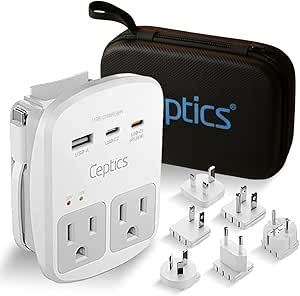 | Best for Destination-Specific Plug Flexibility | USB outputs: 1 USB-A, 1 USB-C, 1 USB-C PD | USB-C PD output: 35W | Outlets: 2 US outlets | VIEW LATEST PRICE | See Our Full Breakdown |
| Ceptics 45W Universal Travel Adapter with 3 USB-A and 2 USB-C Ports |  | Best for Fast Multi-Device Charging | Model: UP-11KU | USB-A ports: 3, 2.4A | USB-C ports: 2 | VIEW LATEST PRICE | See Our Full Breakdown |
| HANYCONY European Travel Plug Adapter with 2 Outlets and 3 USB Ports |  | Best Lightweight Pick for European Trips | Model: HN23T | Plug type: Type C | AC outlets: 2 | VIEW LATEST PRICE | See Our Full Breakdown |
| EPICKA Universal Travel Adapter with 1 AC, 3 USB-C, and 2 USB-A Ports |  | Best for Broad Destination Coverage | Model: TA-105+ | Ports: 1 AC outlet, 3 USB-C, 2 USB-A | Plug types: EU, US, UK, AUS | VIEW LATEST PRICE | See Our Full Breakdown |
| Kenayo Worldwide Universal Travel Power Adapter |  | Best for Built-In Surge Protection | Model number: 674276690397 | Countries supported: Over 100 | Voltage conversion: Does not convert voltage | VIEW LATEST PRICE | See Our Full Breakdown |
| LENCENT Foldable European Travel Plug Adapter with 4 Outlets and 4 USB Ports |  | Best for Multiple AC Plugs in Europe | Model: PA050USEU | Plug type: Type C | AC outlets: 4 | VIEW LATEST PRICE | See Our Full Breakdown |
| portable travel power adapter | USB ports | Plug types | Weight |
|---|---|---|---|
| Anker Nano 5-in-1 Travel Adapt | 2 USB-C, 2 USB-A | Type A, C, G, I | 3.77 oz |
| Anker Nano 5-in-1 Universal Tr | — | Type A, C, G, I | 3.77 oz |
| EPICKA 70W GaN Universal Trave | 3 USB-C, 2 USB-A | Type A, C, G, I | — |
| TESSAN European Travel Plug Ad | 2 USB-A; 1 USB-C | — | — |
| Ceptics 35W Universal Travel A | — | — | 128 g |
| Ceptics 45W Universal Travel A | — | A, C, G, I | 5.9 oz |
| HANYCONY European Travel Plug | 2 USB-C and 1 USB-A | — | 2.4 oz |
| EPICKA Universal Travel Adapte | — | EU, US, UK, AUS | — |
| Kenayo Worldwide Universal Tra | — | — | — |
| LENCENT Foldable European Trav | 2 USB-C and 2 USB-A | — | — |
More Details on Our Top Picks
Anker Nano 5-in-1 Travel Adapter, 20W
For travelers who want one small adapter for a phone, earbuds, and a few other devices, this Anker combines four USB ports and one AC outlet in a body measuring just 3.39 × 1.97 × 0.98 inches. Its foldable, retractable pins support Type A, C, G, and I, making it more destination-flexible than the Europe-only TESSAN Type C adapter. One USB-C port can deliver up to 20W when used alone, though total USB output falls to 15W when multiple ports share power, so five connected devices will not all charge quickly. The main limitation is the AC outlet: it does not accept grounded plugs, and this adapter does not convert voltage. I’d pick it for light, multi-device travel, not for grounded equipment or power-hungry appliances.
Pros:- Four plug types cover many common international destinations.
- Four USB ports plus an AC outlet can serve up to five devices.
- Foldable, retractable pins and a 3.77-ounce weight make it easy to pack.
- One USB-C port provides up to 20W when used on its own.
Cons:- The AC outlet does not support grounded plugs.
- It does not convert voltage, so connected equipment must support the local supply.
- Shared USB output is limited to 15W when charging multiple devices.
Best for: Light packers traveling across regions who want a compact adapter for phones, earbuds, and other ungrounded devices.
Not ideal for: Travelers carrying grounded three-prong equipment or devices that require voltage conversion.
- USB ports:2 USB-C, 2 USB-A
- AC outlets:1
- Maximum USB output:20W; 15W shared
- Plug types:Type A, C, G, I
- Dimensions:3.39 × 1.97 × 0.98 in
- Weight:3.77 oz
- Voltage conversion:Not supported
- Grounded plugs:Not supported
Our verdict“Choose this Anker for compact, multi-device charging across common plug regions, provided you do not need grounding or voltage conversion.”
Anker Nano 5-in-1 Universal Travel Adapter, 20W
This white version of Anker’s Nano keeps the same travel-friendly balance as the black model: two USB-C ports, two USB-A ports, and one AC outlet fit into a compact, foldable-pin design. It suits travelers who want a light adapter that can charge several small devices without carrying a separate USB hub. Compared with the EPICKA 70W adapter, though, its 20W maximum USB output is better suited to phones and accessories than faster-charging laptops. The total drops to 15W when USB power is shared, and the AC outlet rejects grounded three-prong plugs. It also supports Type A, C, G, and I rather than every socket format, and it does not convert voltage. Choose it for modest charging needs and a white finish; skip it if your kit includes grounded gear or needs more USB-C power.
Pros:- Four USB ports and an AC outlet allow up to five devices to connect.
- Foldable, retractable pins help keep the adapter compact in a bag.
- Supports Type A, C, G, and I plug formats.
- Single USB-C output reaches up to 20W.
Cons:- USB output is limited to 15W when shared among multiple ports.
- The AC outlet does not accept grounded three-prong plugs.
- It does not convert voltage.
Best for: Travelers with phones, earbuds, and small accessories who prefer a compact white adapter with multiple USB ports.
Not ideal for: Laptop-focused travelers who need higher USB-C output, or anyone bringing grounded plugs or voltage-incompatible equipment.
- Ports and outlets:1 AC, 2 USB-A, 2 USB-C
- Maximum USB output:20W total; 15W shared
- Single USB-C output:Up to 20W
- Plug types:Type A, C, G, I
- Dimensions:3.39 × 1.97 × 0.98 in
- Weight:3.77 oz
- Voltage conversion:Not supported
- Warranty:18 months
Our verdict“Pick this white Anker for compact charging of several everyday devices, but choose the EPICKA 70W if faster USB-C charging is a priority.”
EPICKA 70W GaN Universal Travel Adapter with 3 USB-C and 2 USB-A Ports
The EPICKA earns its place for travelers who need more than phone-level USB charging: its USB-C1 port supports PD 3.0 up to 70W, well above the 20W ceiling of either Anker Nano. Three USB-C ports and two USB-A ports also give it a stronger setup for a mix of newer and older devices, alongside one AC outlet. Its four plug types are listed for use in more than 200 countries and regions, though it is not compatible with Type D or Type M sockets. A built-in 10A fuse, safety shutters, plug lock, and spare fuses add practical safeguards, but there is no surge protection. Like the other universal adapters here, it does not convert voltage; it is also not recommended for appliances over 2000W. I’d choose it for USB-C-heavy travel, not as a converter for appliances.
Pros:- USB-C1 delivers up to 70W with PD 3.0 support.
- Three USB-C and two USB-A ports handle a varied device mix.
- Four plug types are listed for use in more than 200 countries and regions.
- Includes safety shutters, a plug lock, a built-in fuse, and two spare fuses.
Cons:- Does not convert voltage, so devices must support the local supply.
- Not compatible with Type D or Type M sockets.
- No surge protection; high-power appliances over 2000W are not recommended.
Best for: Travelers who charge a USB-C laptop or other higher-draw USB-C device alongside phones and accessories.
Not ideal for: People visiting destinations that require Type D or M plugs, or carrying appliances that need voltage conversion or exceed 2000W.
- USB ports:3 USB-C, 2 USB-A
- Maximum USB-C1 output:70W PD 3.0
- Plug types:Type A, C, G, I
- Country compatibility:More than 200 countries and regions
- AC outlet:1
- Fuse:Built-in 10A; 2 spare fuses included
- Surge protection:None
- Voltage conversion:Not supported
Our verdict“Choose the EPICKA if faster USB-C charging matters more than the Anker Nano’s smaller, simpler profile, and your destination uses a supported plug type.”
TESSAN European Travel Plug Adapter, 2-Pack, Type C
For a trip centered on destinations that accept Type C plugs, this two-pack favors outlet access over worldwide versatility: each adapter has four AC outlets, two USB-A ports, and one USB-C port. That can be useful when a hotel room has few wall sockets and several travelers need to charge at once. The tradeoff is narrower geography than either Anker Nano or the EPICKA, since this model is not compatible with the UK, Ireland, or Scotland. Its USB-C output tops out at 15W, below the EPICKA’s 70W USB-C option, so it is a better fit for phones and small devices than laptop charging. It accepts 100–250V input but does not convert voltage, and there is no surge protection. I’d favor this pair for shared European stays, not for multi-region itineraries.
Pros:- Two adapters provide four AC outlets and three USB ports each.
- Useful outlet count for rooms with limited wall sockets.
- Lightweight design at 3.48 ounces per adapter.
- Supports 100–250V input for compatible devices.
Cons:- Type C plug format is not compatible with the UK, Ireland, or Scotland.
- Does not convert voltage and has no surge protection.
- USB-C output is limited to 15W.
Best for: Couples or families staying in Type C-compatible European destinations who need extra AC outlets for small, compatible devices.
Not ideal for: Travelers visiting the UK, Ireland, or Scotland, or those needing worldwide plug coverage, surge protection, or high-power USB-C charging.
- Pack quantity:2
- Plug type:Type C
- AC outlets:4 per adapter
- USB ports:2 USB-A; 1 USB-C
- USB-C output:Up to 15W
- Input voltage:100–250V
- Maximum power:2500W at 250V; 1000W at 100V
- Surge protection:None
Our verdict“Choose this two-pack for shared charging in Type C-compatible European destinations, but use a universal adapter for trips that include the UK or multiple plug regions.”
Ceptics 35W Universal Travel Adapter Kit with 2 US Outlets, USB-A, USB-C, and Travel Pouch
Ceptics takes a kit-based approach: instead of built-in retractable pins like the Anker Nano, it includes six separate plug adapters covering Type C, G, B, I, E/F, and A. That broader assortment suits itineraries spanning different socket formats, while the two US outlets let travelers plug in familiar devices. Its 35W USB-C PD output is stronger than the Anker’s 20W single-port maximum, though the EPICKA reaches 70W for travelers with more demanding USB-C gear. Built-in surge protection and a voltage indicator are useful additions, and the pouch keeps the pieces together; the tradeoff is more kit to manage. Ceptics supports 100–240V devices but does not convert voltage, so a device that only supports 110V is not suitable. I’d choose it for travelers who value plug options and protection over an all-in-one pin design.
Pros:- Six plug adapters cover Type C, G, B, I, E/F, and A.
- 35W USB-C PD output exceeds the Anker Nano’s 20W single-port maximum.
- Built-in surge protection and a voltage indicator.
- Includes two US outlets, a USB-C cable, and a travel pouch.
Cons:- Separate plug adapters mean more pieces to keep track of than the Anker Nano’s foldable-pin design.
- Does not convert voltage.
- Not suitable for devices that only support 110V.
Best for: Multi-destination travelers who want several plug formats, two US outlets, a travel pouch, and built-in surge protection.
Not ideal for: People seeking a single integrated adapter with minimal loose parts, or travelers carrying devices that only support 110V.
- USB outputs:1 USB-A, 1 USB-C, 1 USB-C PD
- USB-C PD output:35W
- Outlets:2 US outlets
- Included plug adapters:6: Type C, G, B, I, E/F, A
- Input voltage:100–240V AC
- Surge protection:Built-in
- Weight:128 g
- Included items:USB-C cable, travel pouch, manual
Our verdict“Pick the Ceptics kit if broad plug-format coverage and surge protection matter more than a single-piece design or the EPICKA’s higher USB-C output.”
Ceptics 45W Universal Travel Adapter with 3 USB-A and 2 USB-C Ports
I’d choose the Ceptics 45W when charging speed matters alongside broad plug compatibility. Its 45W USB-C Power Delivery port can serve compatible phones, tablets, and some laptops, while three USB-A ports and a second USB-C port let me connect several smaller devices. Compared with the EPICKA TA-105+, it offers a higher-powered USB-C option, though EPICKA has three USB-C ports and a spare fuse. The Ceptics supports Type A, C, G, and I plugs in a compact body, but it does not convert voltage; appliances must support 100–240V. Its 8A fuse and safety features add reassurance, yet this is not the pick for 110V-only hair tools or travelers who need a separate voltage converter.
Pros:- 45W USB-C Power Delivery supports faster charging for compatible devices
- Five USB ports plus a universal AC socket handle a multi-device kit
- Supports Type A, C, G, and I plug formats
- Includes an 8A fuse and built-in safety features
Cons:- Does not convert voltage, so appliances must support the local supply
- Not suitable for 110V-only heating appliances
- USB-A charging is limited to 2.4A per port
Best for: Travelers carrying a USB-C laptop or tablet plus several phones and accessories who need one adapter for destinations using A, C, G, or I plugs.
Not ideal for: Anyone bringing a 110V-only hair dryer or curling iron, or seeking a voltage converter rather than a plug adapter.
- Model:UP-11KU
- USB-A ports:3, 2.4A
- USB-C ports:2
- USB-C Power Delivery:45W
- Plug types:A, C, G, I
- Fuse:8A
- Weight:5.9 oz
- Dimensions:2 × 1.8 × 3 in
- Warranty:1 year
Our verdict“Choose the Ceptics if you want a versatile plug adapter with a 45W USB-C port, but skip it for single-voltage appliances.”
HANYCONY European Travel Plug Adapter with 2 Outlets and 3 USB Ports
For a Europe-focused packing list, I like the HANYCONY HN23T for its low 2.4-ounce weight and two AC outlets. Three USB ports, including two USB-C, bring the total to five connected devices without the bulk of a universal adapter such as the EPICKA TA-105+. That compactness comes with a narrower destination range: this is a Type C adapter and does not work in the UK, Ireland, or Scotland. Its USB output is capped at 15.5W total, so it is better for phones and smaller accessories than power-hungry laptop charging. I’d also factor in the lack of surge protection and voltage conversion; dual-voltage appliances are required, and single-voltage heating tools are a poor match.
Pros:- Lightweight 2.4-ounce design suits carry-on packing
- Two AC outlets and three USB ports can charge up to five devices
- Two USB-C ports support newer charging cables
- Rated for compatible dual-voltage appliances up to 2500W
Cons:- Type C plug does not work in the UK, Ireland, or Scotland
- No surge protection or voltage conversion
- USB output is limited to 15.5W total
Best for: Light packers visiting Type C European destinations who want to charge phones, earbuds, and other small devices from one wall adapter.
Not ideal for: Travelers visiting the UK, Ireland, or Scotland, or anyone needing surge protection, voltage conversion, or higher-wattage USB charging.
- Model:HN23T
- Plug type:Type C
- AC outlets:2
- USB ports:2 USB-C and 1 USB-A
- USB output:5V, 3.1A total; 15.5W maximum
- Maximum power:2500W
- Maximum voltage:250V
- Weight:2.4 oz
- Surge protection:None
Our verdict“Pick the HANYCONY for light, small-device charging on compatible European trips, not for UK travel or high-powered USB needs.”
EPICKA Universal Travel Adapter with 1 AC, 3 USB-C, and 2 USB-A Ports
The EPICKA TA-105+ is the strongest fit here for travelers who move between regions and want one adapter for a broad mix of wall plugs. Its EU, US, UK, and AUS plug types cover more ground than the Europe-only HANYCONY and LENCENT adapters, and its six charging connections include three USB-C ports. I’d favor it for a mixed-device travel kit, though the Ceptics 45W is the better choice when a clearly specified high-power USB-C PD port matters. EPICKA instead offers a replaceable 10A fuse, a spare, safety shutters, and a plug lock. It still does not convert voltage, and its AC outlet is not intended for high-power appliances such as hair dryers. There is also no storage bag included.
Pros:- Four plug types cover a wide range of destinations
- Three USB-C and two USB-A ports charge multiple devices alongside the AC outlet
- Replaceable 10A fuse with one spare included
- Safety shutters and a plug lock add practical safeguards
Cons:- Does not convert voltage
- Not intended for high-power appliances such as hair dryers
- No storage bag is included
Best for: Frequent international travelers carrying several USB-C devices who want one adapter for destinations using EU, US, UK, or AUS plugs.
Not ideal for: Travelers who need voltage conversion, a high-power appliance connection, or a dedicated storage pouch.
- Model:TA-105+
- Ports:1 AC outlet, 3 USB-C, 2 USB-A
- Plug types:EU, US, UK, AUS
- USB-C output:3A
- USB-A output:2.4A
- Maximum power:1100W at 110V; 2400W at 240V
- Fuse:Replaceable 10A fuse; one spare included
- Safety features:Safety shutters and plug lock
- Warranty:2-year limited
Our verdict“Choose EPICKA for broad plug coverage and several USB-C connections, provided your appliances support local voltage.”
Kenayo Worldwide Universal Travel Power Adapter
I’d put the Kenayo Worldwide on the shortlist for travelers who value built-in surge protection in a compact all-in-one adapter. It supports plugs for over 100 countries and adds a fuse system and safety shutters, making its protection features a point of difference from the HANYCONY and LENCENT, which list no surge protection. The tradeoff is that the product data gives little detail about charging ports or device capacity, so I can’t recommend it as confidently for a large USB-device load as the EPICKA TA-105+, which specifies its port layout. Kenayo also does not convert voltage. Its input and output are listed in watts rather than volts, which leaves voltage compatibility unclear; I’d verify device and local-supply requirements before plugging in sensitive equipment.
Pros:- Plug compatibility covers more than 100 countries
- Combines multiple plug formats in one adapter
- Includes surge protection, a fuse system, and safety shutters
Cons:- Does not convert voltage
- Input and output ratings are listed in watts, making voltage compatibility unclear
- Available product details do not specify USB ports or a full port layout
Best for: Travelers who want a compact multi-region plug adapter with surge protection and a fuse system, and who can verify device compatibility before use.
Not ideal for: Buyers who need clearly specified USB charging ports, precise electrical ratings, or voltage conversion for single-voltage appliances.
- Model number:674276690397
- Countries supported:Over 100
- Voltage conversion:Does not convert voltage
- Input:100–240W, as listed
- Output:100–240W, 6A maximum, as listed
- Safety features:Surge protection, fuse system, safety shutters
- Items included:1 adapter
Our verdict“Choose Kenayo if surge protection and broad plug coverage matter more than detailed port specifications, but verify voltage compatibility first.”
LENCENT Foldable European Travel Plug Adapter with 4 Outlets and 4 USB Ports
When several travelers need to plug in at once, the LENCENT PA050USEU stands apart with four AC outlets plus four USB ports, supporting up to eight connections from a single Type C wall plug. That outlet count is more useful for shared hotel-room charging than the lighter HANYCONY, which has two AC outlets and three USB ports. Its foldable design and 4.2-ounce weight help keep the adapter manageable, but it is limited to Type C destinations and does not cover the UK or other Type G locations. USB output totals just 17.5W, so this is mainly a multi-device convenience hub, not a fast-charging solution. Like the other plug adapters here, it does not convert voltage, and it also lacks surge protection and a cord.
Pros:- Four AC outlets and four USB ports can serve up to eight devices
- Foldable design helps with packing and storage
- USB-C and USB-A ports accommodate a mix of cable types
- Rated for compatible devices up to 2500W
Cons:- Type C plug is not suitable for UK and other Type G destinations
- Does not convert voltage or provide surge protection
- Total USB output is limited to 17.5W, and no cord is included
Best for: Couples or families staying in Type C destinations who need several AC outlets and USB connections from one wall socket.
Not ideal for: Travelers heading to the UK or other Type G destinations, or those who need surge protection, voltage conversion, or a corded power strip.
- Model:PA050USEU
- Plug type:Type C
- AC outlets:4
- USB ports:2 USB-C and 2 USB-A
- USB-C output:5V/3A; 15W maximum per port
- USB-A output:5V/2.4A; 12W maximum per port
- Total USB output:5V/3.5A; 17.5W maximum
- Maximum capacity:2500W at 250V, 10A
- Size and weight:2.3 × 1.6 × 3.1 in; 4.2 oz
Our verdict“Pick the LENCENT for shared charging at Type C outlets, but choose a different adapter for Type G destinations or surge protection.”

How We Picked
I compared these portable travel power adapters by how well their stated features match common trip needs: plug compatibility, USB port mix, published charging output, AC outlet access, portability, and the clarity of their use case. A higher wattage or larger port count only helped the ranking when it translated into a meaningful advantage, such as supporting several devices or offering more headroom for USB-C charging. I also weighed whether a product is designed for broad international use or a narrower destination, since a compact regional adapter can be a better travel choice than a bulkier all-in-one unit.
The ranking favors versatility and useful charging capacity first, then practical simplicity and destination fit. That puts the EPICKA 70W model ahead for travelers carrying several devices, while the Anker Nano and European plug adapters serve lighter or more specific needs. Products with multiple outlets and ports may suit groups, but they can take up more space and still require attention to output limits. Product names and stated specifications do not establish independent performance testing, so I treat wattage, port counts, and plug types as selection criteria rather than guarantees of real-world charging speed.
| portable travel power adapter | Plug types |
|---|---|
| Anker Nano 5-in-1 Travel Adapt | Type A, C, G, I |
| Anker Nano 5-in-1 Universal Tr | Type A, C, G, I |
| EPICKA 70W GaN Universal Trave | Type A, C, G, I |
| TESSAN European Travel Plug Ad | — |
| Ceptics 35W Universal Travel A | — |
| Ceptics 45W Universal Travel A | A, C, G, I |
| HANYCONY European Travel Plug | — |
| EPICKA Universal Travel Adapte | EU, US, UK, AUS |
| Kenayo Worldwide Universal Tra | — |
| LENCENT Foldable European Trav | — |
Factors to Consider When Choosing Portable Travel Power Adapters
Choosing an adapter starts with your destination and devices, not the number of ports on the package. I would check plug shape, charging needs, and voltage compatibility before comparing convenience features. These broader checks help avoid buying an adapter that fits the wall but cannot safely or quickly power what you brought.
Match plug types to every stop on your itinerary
A multi-region adapter is useful when a trip crosses countries with different outlet shapes, but it may be larger than a plug designed for one region. Check each destination’s plug type rather than assuming neighboring countries use the same standard. European Type C models are aimed at compatible outlets, not worldwide coverage. If you travel to one region repeatedly, a dedicated adapter can be a simpler and lighter choice. For a multi-country itinerary, broad coverage may reduce the number of separate plugs you carry. Also check whether the adapter’s plug mechanism supports the specific outlet type you need.
Separate plug adaptation from voltage conversion
A travel adapter changes the physical connection between your device plug and the wall outlet; it does not necessarily change the electrical voltage. Many phone and laptop chargers accept a range of input voltages, but appliances such as some hair tools may not. Read the input label on each device and compare it with the destination’s supply before packing. If a device is single-voltage, a plug adapter alone may not make it suitable for use abroad. Voltage converters have their own wattage limits and may not work with every appliance. Checking device labels before departure can prevent damage and avoid an unnecessary converter purchase.
Choose USB-C wattage for your most demanding device
Port count tells you how many devices can connect, while wattage helps indicate how much charging power is available. A 20W adapter may be a sensible phone-focused pick, but a laptop or tablet may charge more slowly or need a higher-rated USB-C connection. Compare the output specification with the requirements of your device’s original charger. When several ports are used at once, power may be shared, so a listed maximum does not necessarily apply to every port simultaneously. If you plan to charge a laptop and a phone together, check the multiport output details rather than relying on the headline wattage. A larger charging unit can add bulk, so pay for extra capacity only when your devices need it.
Decide how much access to AC outlets you need
USB ports are convenient for phones and tablets, but an AC outlet remains useful for a camera charger, laptop power brick, or another device with a standard plug. Multiple outlets can help couples or families share one wall socket. They can also make an adapter wider, heavier, or more likely to block a neighboring outlet. Check the outlet orientation and the total load limits, especially when charging several devices together. A traveler carrying only USB-charged electronics may prefer a smaller adapter with no extra AC sockets. Do not treat several sockets as permission to connect high-power appliances beyond the product’s stated limits.
Balance a one-piece adapter against separate regional plugs
All-in-one adapters reduce the need to pack several destination-specific pieces, which can make them appealing for changing itineraries. Their mechanisms and extra ports often mean more size and weight than a basic regional plug. A two-pack of regional adapters can be useful when devices need to charge in separate rooms or when one adapter stays in a day bag. Separate units also offer a backup if one is misplaced, though they may cover fewer destinations. Think about how often your travel plans change and whether you value coverage or compactness more. For long stays in one country, a simpler regional option may be the less cumbersome choice.
Check safety marks, physical fit, and airline packing needs
Before buying, review the manufacturer’s stated safety certifications, power limits, and instructions for each plug configuration. A universal adapter can fit many outlet shapes without being suitable for every device or load. Check whether the product’s body could obstruct a neighboring wall socket, particularly in older hotels with closely spaced outlets. Foldable or detachable parts can help with packing, but they still need to lock or seat securely during use. Keep the adapter’s limits accessible when charging several devices, and stop using it if the plug or casing becomes unusually hot. For air travel, follow the airline’s rules for any batteries or powered accessories you carry; a plug adapter itself is not a substitute for those checks.
Frequently Asked Questions
Can I charge a laptop with one of these portable travel power adapters?
Possibly, but check both the laptop’s charging requirement and the adapter’s USB-C output details. The EPICKA 70W model has more stated charging headroom than the Anker Nano 20W options, making it the more plausible fit for some USB-C laptops. That does not mean every laptop will charge at full speed, particularly if other ports are in use. Compare the laptop charger’s required wattage with the adapter’s output and shared-power specifications. If your laptop uses a separate AC power brick, check that the adapter’s outlet and load limits support it.
Will a universal travel adapter let me use a hair dryer abroad?
Not by itself in every case. A universal adapter generally changes the plug shape, not the voltage, and many hair dryers draw more power than compact travel adapters are designed to handle. Read the hair dryer’s input label and confirm whether it supports the destination’s voltage. If it is single-voltage, a plug adapter alone can create a risk of damage or unsafe operation. A dual-voltage travel dryer or a properly specified converter may be a better fit, subject to its power rating and the device instructions.
Should I choose a 70W model or a smaller 20W adapter?
Choose based on the devices you need to charge, not wattage alone. A 20W model can suit a phone-focused traveler who values a compact setup, while a 70W option offers more headroom for several devices and some USB-C laptops. Higher stated output may come with a larger body and can be shared across ports when multiple devices are connected. Check how much power each port supplies under simultaneous use. If you rarely charge anything beyond a phone and earbuds, extra capacity may add bulk without a useful benefit.
Is a European Type C adapter enough for a multi-country trip?
Only if the destinations on your itinerary accept the plug type and device connection you plan to use. A European Type C adapter is narrower in scope than a worldwide model, so it may not cover every country or outlet style on a multi-region trip. Check the plug standard for every stop, including any layovers where you expect to charge devices. Travelers staying within compatible destinations may appreciate the straightforward regional fit and a two-pack for separate locations. For a trip spanning several plug types, a broad-coverage adapter or a set of regional adapters may be more suitable.
Can several devices charge at full speed at the same time?
Not necessarily. A product’s maximum wattage may describe total output rather than the power available from every port at once. When several devices are connected, the adapter may divide its available power, and each port can have a different limit. Check the multiport output table or instructions for the exact combination you expect to use. For a laptop, phone, and tablet charged together, choose a model with enough total capacity and a clear simultaneous-output specification. If that information is unavailable, plan for slower charging or use separate chargers for the most demanding devices.
Conclusion
I would choose the EPICKA 70W GaN Universal Travel Adapter as the best overall option for travelers who want substantial USB-C capacity and multiple charging ports in one unit. The Anker Nano 5-in-1 is my best compact, beginner-friendly pick for phones and lighter device loads, while the TESSAN Type C 2-Pack is a practical value choice for travelers whose plans focus on compatible European outlets. For a more demanding USB-C setup, compare the 70W EPICKA with the Ceptics 45W and check each model’s shared-output details before deciding. The Ceptics 35W kit makes more sense when two AC outlets and a travel pouch matter more than maximum charging output; the LENCENT and HANYCONY suit travelers prioritizing multiple outlets or USB connections, while the Kenayo may appeal to someone seeking a worldwide-format adapter. My final check would be destination plug compatibility, device voltage, and simultaneous power needs—those determine whether the most feature-rich option is actually the right travel fit.
Evergreen bestsellers Picks

Ninja Foodi 10-Quart DualZone 6-in-1 Air Fryer, Black, DZ302

Vitamix 5200 Professional-Grade Blender, 64 oz. Container, Black

Roborock Q10 S5+ Robot Vacuum and Mop with Self-Emptying Station
As an affiliate, we earn on qualifying purchases.