
TL;DR

Get travel and outdoor gear delivered free with Prime
- Fast, free delivery on millions of items
- Prime Video, Amazon Music and more included
- Member-only deals all year
Your power bank’s watt-hours show how much energy it stores. Most airlines allow batteries under 100 Wh freely, but larger ones need approval. Calculating Wh from mAh is simple—just multiply capacity by voltage and divide by 1000. Always check your device’s Wh before flying.
Always find the watt-hour rating of your power bank before flying. It’s the key to airline compliance.
Convert mAh to Wh by multiplying capacity by voltage (usually 3.7V), then dividing by 1000.
Power banks under 100 Wh are generally safe to carry without approval, but larger ones need airline consent.
Always carry larger batteries in your carry-on, never checked luggage, to avoid confiscation.
Double-check airline rules as they can vary; when in doubt, ask and declare if necessary.
What exactly is watt-hours and why does it matter for flying?
Watt-hours (Wh) measure the actual energy stored in your power bank. It’s what airlines and regulators care about because it directly relates to fire risk. A power bank with 50 Wh is considered less risky than one with 150 Wh, even if they have the same mAh rating. For example, a typical 10,000 mAh power bank at 3.7V holds about 37 Wh, well under most airline limits.
Knowing your Wh helps you avoid surprises at security and ensures you follow airline rules. The FAA, TSA, and other authorities prioritize Wh because it’s a straightforward safety metric, unlike mAh, which varies with voltage. So, understanding Wh keeps your electronics flying with you, not in the cargo hold.
As an affiliate, we earn on qualifying purchases.
How to convert your power bank’s capacity from mAh to Wh in 3 easy steps
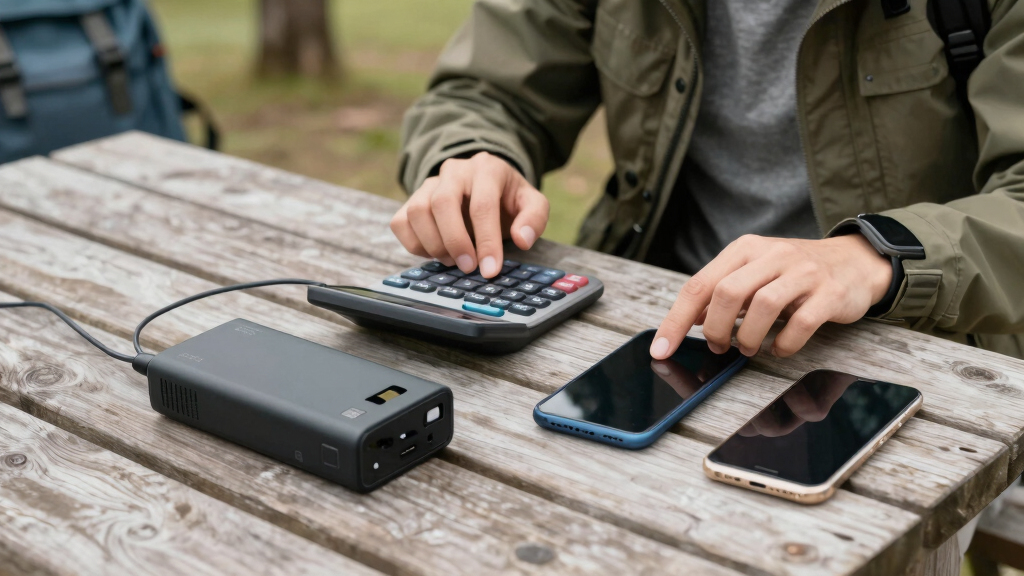
Most power banks list capacity in milliamp-hours (mAh), but to know if you’re good for airline travel, you need watt-hours (Wh). Here’s how to convert:
- Find the voltage (V). Most lithium-ion batteries run at 3.7V.
- Multiply mAh by voltage: mAh x V = mWh (milliwatt-hours).
- Divide mWh by 1000 to get Wh: (mWh / 1000) = Wh.
For example, a 10,000 mAh power bank at 3.7V: 10,000 x 3.7 = 37,000 mWh; then, 37,000 / 1000 = 37 Wh. Easy!
Always check the label or specs for mAh and voltage. If missing, use 3.7V as a default for lithium-ion cells.
airline approved portable charger 100Wh
As an affiliate, we earn on qualifying purchases.
As an affiliate, we earn on qualifying purchases.
Compare common power bank sizes and airline rules side-by-side
| Capacity in Wh | Airline Rule | Notes |
|---|---|---|
| Under 100 Wh | Allowed without approval | Most portable power banks fall here |
| 100-160 Wh | Requires approval | Often used by frequent travelers |
| Over 160 Wh | Prohibited on passenger flights | Usually only for professional or specialized equipment |
For instance, a 50 Wh power bank is safe to carry without notifying anyone. But if your device hits 130 Wh, you’ll need airline approval first.
large capacity power bank 10000mAh
As an affiliate, we earn on qualifying purchases.
As an affiliate, we earn on qualifying purchases.
What to do if your power bank is close to or over the limit
If your power bank’s capacity is near 100 Wh or more, don’t just toss it in your bag and forget about it. Check with your airline beforehand. Some allow larger batteries with prior approval, but many prohibit them altogether. Always carry these in your hand luggage, never checked bags.
For example, a photographer’s 150 Wh battery pack might need special permission. Contact the airline’s customer service or check their website to get approval in advance. Failing to do so could mean confiscation or delays.
Remember: the goal is to keep your devices with you, not in the baggage hold where they’re more likely to be damaged or lost.
As an affiliate, we earn on qualifying purchases.
Quick checklist to prep your power bank for air travel
- Check the mAh and voltage on your device.
- Calculate the Wh using the formula.
- If under 100 Wh, pack it in carry-on without worry.
- If between 100-160 Wh, seek airline approval.
- Over 160 Wh? Consider leaving it at home.
- Declare batteries over 100 Wh at security if required.
For example, before a flight, double-check that your 13,000 mAh, 3.7V power bank is about 48 Wh. You’re clear to pack.
Frequently Asked Questions
How do I find the watt-hours of my power bank?
Look for the mAh and voltage listed on your device or packaging. Multiply mAh by voltage, then divide by 1000 to get Wh. For example, 10,000 mAh at 3.7V equals 37 Wh.
Can I bring my large power bank on a plane?
If it’s under 100 Wh, yes. Between 100 and 160 Wh, you need airline approval. Over 160 Wh, it’s usually not allowed. Always check your airline’s specific rules before flying.
Why do airlines care about watt-hours instead of mAh?
Watt-hours directly measure the energy capacity, which correlates with fire risk and safety regulations. mAh varies with voltage and doesn’t give a complete picture of energy stored.
What if my power bank doesn’t list Wh?
Calculate it yourself using the mAh and voltage. If missing, use 3.7V as a standard for lithium-ion batteries and follow the formula.
Are there exceptions or special rules for certain batteries?
Some airlines or countries may have stricter rules. Always verify with your airline or local regulations, especially for batteries over 100 Wh.
Conclusion
Knowing your power bank’s watt-hours isn’t just a number — it’s your ticket to smooth travel. Take a moment to do the math, and you’ll avoid last-minute surprises at security. Your devices stay charged and your trip stays hassle-free.
Next time you pack, picture that tiny Wh number as your travel passport for batteries. Keep it safe, keep it legal, and enjoy your journey with peace of mind.
Columbus Day / Indigenous Peoples' Day Picks
long weekend sales
As an affiliate, we earn on qualifying purchases.